Joining the Glider Pilot Regiment
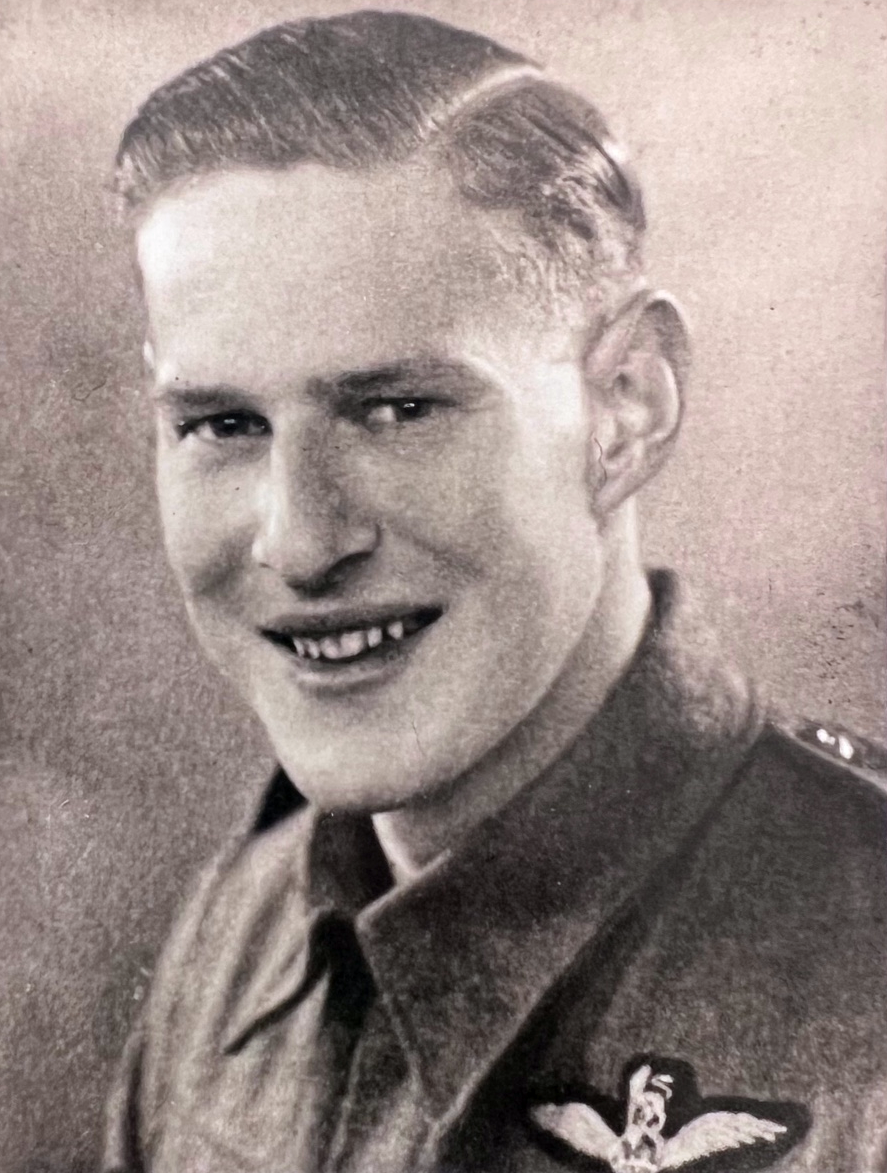
John Henry Stevens enlisted around 1942–43, serving first in the Guards for approximately two years before transferring to the Glider Pilot Regiment. The GPR was urgently rebuilding after catastrophic losses at Arnhem in September 1944, and was fast-tracking recruits through training. John’s service number was 2665293.
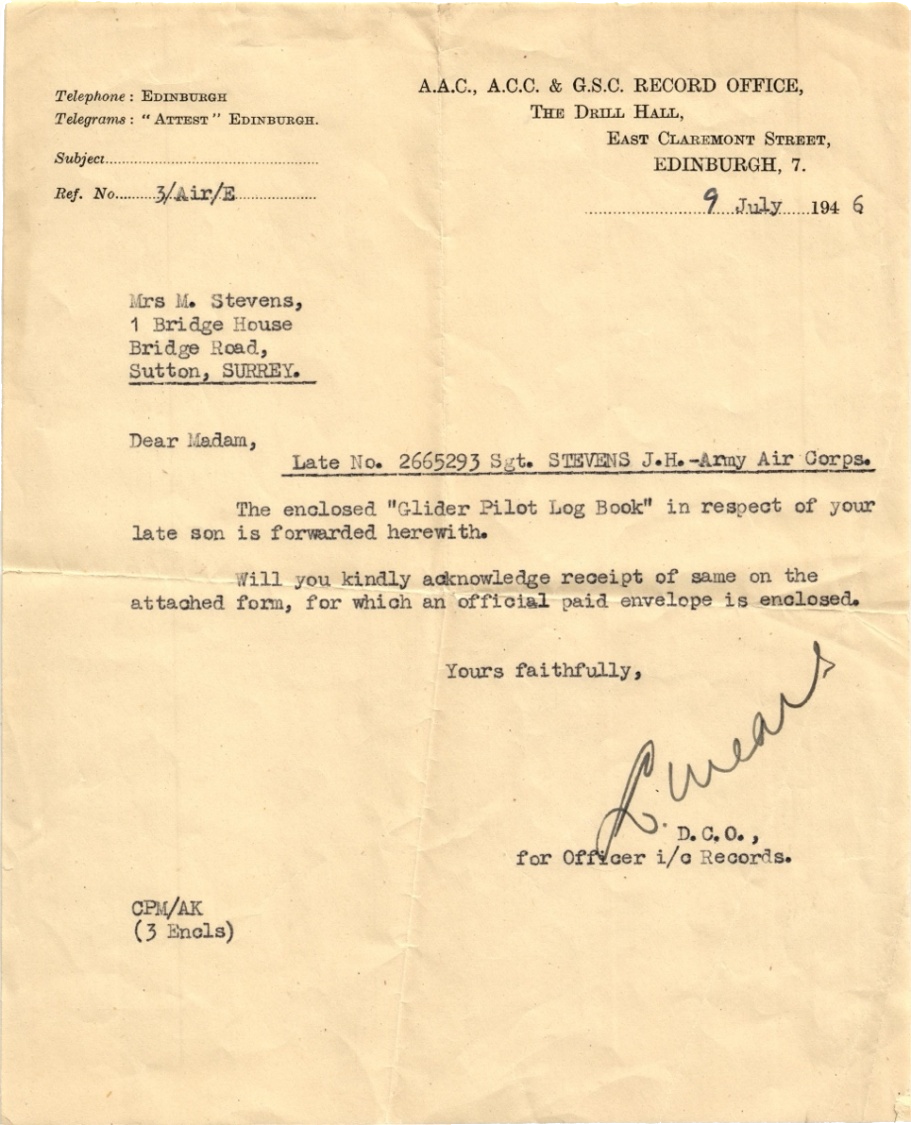
His flying training is documented in extraordinary detail — his RAF Form 414 Pilot’s Flying Log Book survives in family custody. Every entry is in John’s own hand, in blue ink. The log book was returned to his mother, Mrs Minnie Stevens, by the Army Air Corps Record Office in Edinburgh on 9 July 1946.
It was lost to the family for decades until April 2023, when it was reunited with the Stevens family through the Glider Pilot Regiment Society.
Phase 1 — Elementary Flying Training
No. 21 EFTS, Denham and Booker
26 May to 19 July 1944
John’s first flight was on 26 May 1944 in Tiger Moth T7103, with Sgt Hildreth as instructor. He was ranked Corporal at this stage. His first solo flight followed on 10 June 1944.
The syllabus covered taxying, straight and level flight, stalling, spinning, forced landings, aerobatics, and cross-country navigation. He accumulated hours steadily through June and July.
Phase 2 — Glider Training
No. 5 GTS, Shobdon
26 July to 5 September 1944
His first Hotspur glider flight was on 29 July 1944, with F/Sgt Beeson as primary instructor. The GTS summary dated 4 September 1944 records: “Not assessed — Course incomplete” — he was fast-tracked as the GPR urgently rebuilt after Arnhem. This was standard practice for the period, not a reflection on his ability.
Phase 3 — Operational Posting
Horsa Mk I and Mk II
September 1944 onwards
John progressed to the Horsa — the primary British military glider of the war, capable of carrying 25 fully equipped troops or a light vehicle. He flew both the Mk I and the heavier Mk II variant.
He joined F Squadron on 15 November 1944, based at RAF Broadwell, Oxfordshire, attached to 15 Flight. Training at this stage included large-scale mass landing exercises — “BALBO” exercises involving up to 309 gliders simultaneously — as well as named exercises “RIFF-RAFF” and “VULTURE.”
The Log Book
The log book runs from 26 May 1944 to 17 March 1945. There is no March monthly summary. He never came back to complete it.
The 17 March 1945 entry is the last thing John Stevens ever wrote in his own hand. He signed the page, closed the log book, and flew to Germany a week later. The book was returned to his mother. The blank pages that follow speak for themselves.
A significant entry in the log book records John flying as second pilot with Captain McMillen throughout February 1945 — establishing them as an established crew pairing in the weeks before Operation VARSITY. This forms a central part of the open question about John’s final flight. See Open Questions.
The Facebook Post That Changed Everything
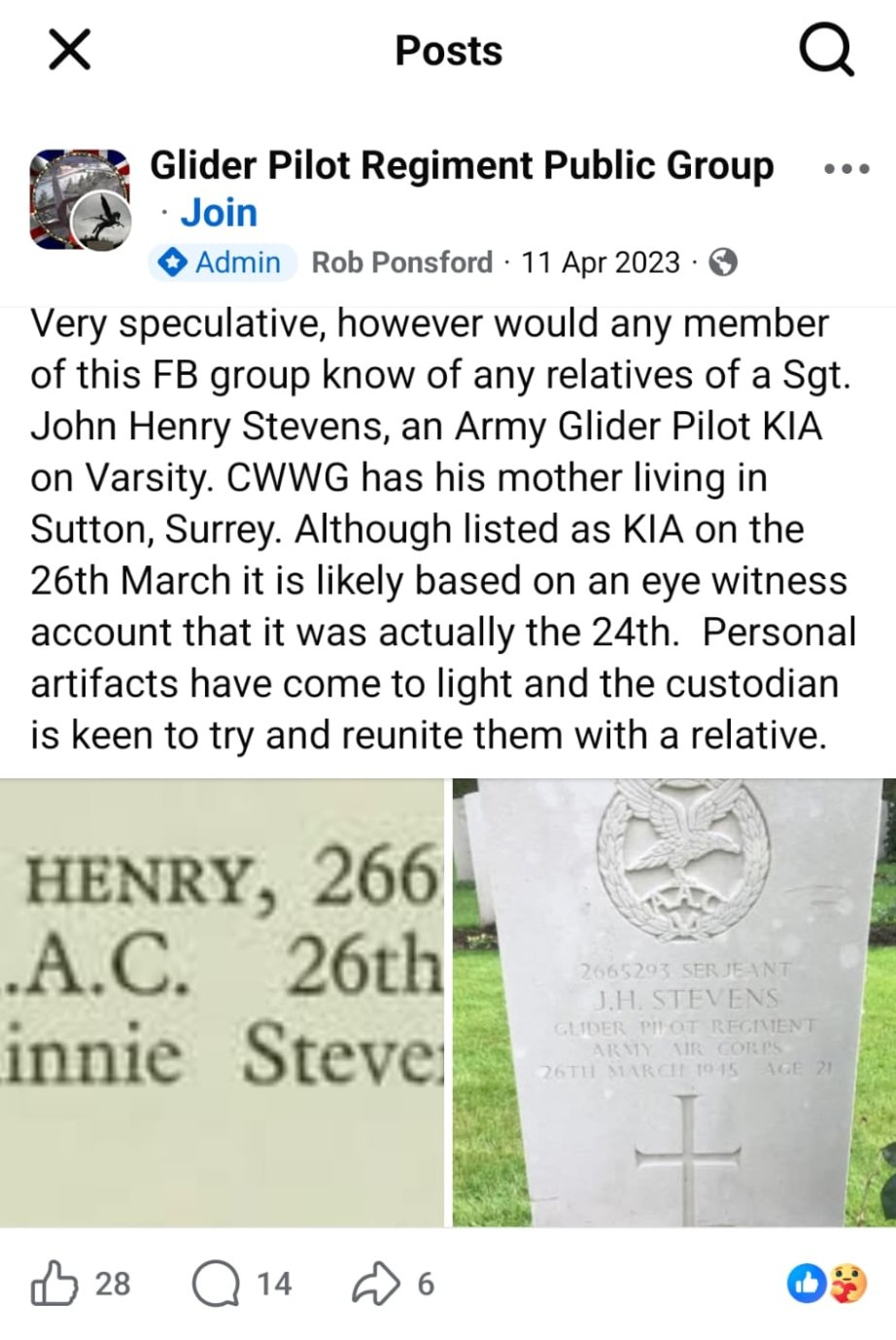
In April 2023, Rob Ponsford posted on the Glider Pilot Regiment Public Group on Facebook that personal artefacts belonging to a Sgt John Henry Stevens had come to light. This single post led directly to the log book being reunited with the family after decades.
Service Summary
| Detail | Record |
|---|---|
| Service number | 2665293 |
| Regiment | Glider Pilot Regiment, Army Air Corps |
| Squadron | F Squadron, 1st Wing |
| Flight | 15 Flight |
| Base | RAF Broadwell, Oxfordshire |
| Joined F Squadron | 15 November 1944 |
| Aircraft flown | Tiger Moth, Hotspur, Horsa Mk I & II |
| First flight | 26 May 1944 |
| Final log entry | 17 March 1945 |
| Rank at death | Sergeant |
Sources: RAF Form 414 Pilot’s Flying Log Book (family custody); National Archives WO 171/5129 — No. 1 Wing GPR War Diary.