The Largest Single-Day Airborne Operation in History
Operation VARSITY was the airborne component of Operation PLUNDER — Field Marshal Montgomery’s crossing of the Rhine. Launched on 24 March 1945, it was the largest single-day airborne operation ever conducted: over 16,000 troops, more than 1,500 aircraft, and over 1,300 gliders, all crossing the Rhine in a single lift.
The objective was to secure the eastern bank of the Rhine north of the Ruhr, linking up with ground forces and opening the way into the heart of Germany. Unlike previous operations — notably the disaster at Arnhem six months earlier — VARSITY was meticulously planned and closely coordinated with the ground assault.
John Henry Stevens was 21 years old. He had been flying with F Squadron for four months.
F Squadron’s Role
F Squadron, 1st Wing, Glider Pilot Regiment was based at RAF Gosfield, Essex, for the operation. The squadron flew 60 Horsa gliders to Landing Zones O and U near Hamminkeln, a small town east of the Rhine.
The War Diary — 24 March 1945
| Time | Event |
|---|---|
| 0500 hrs | Final briefing, RAF Gosfield |
| 0600 hrs | Take-off. 60 Horsa gliders |
| 1015 hrs | Landing on LZs O and U, Hamminkeln. Visibility poor. Moderate to concentrated anti-aircraft fire. Many aircraft crashed or destroyed by fire |
| Afternoon | Squadron assembled at rendezvous under S/Ldr Reynolds DFC. Dug in |
| 1900–0700 | Enemy infiltration overnight — approximately 50 men and a self-propelled gun. Driven out by daybreak |
25–27 March
| Date | Event |
|---|---|
| 25 March | Enemy tank attack with infantry. Two tanks destroyed |
| 26 March 0500 | Squadron moved through Hamminkeln under 88mm shellfire |
| 27 March | Marched to the Rhine. Crossed by pontoon bridge. Reached Camp Cornucopia |
| 31 March | Debriefing. F Squadron total casualties: 44. Army pilots killed: 11. RAF pilots killed: 12 |
John Henry Stevens — 24 March 1945
John Henry Stevens was killed in action on 24 March 1945 — the day of the landing. He was 21 years old.
He was initially buried at Hamminkeln — recorded as “a point 8 miles South of Bocholt.” The battlefield cross photograph, taken by the CWGC in the immediate post-war period, shows his marker as it stood in the field.
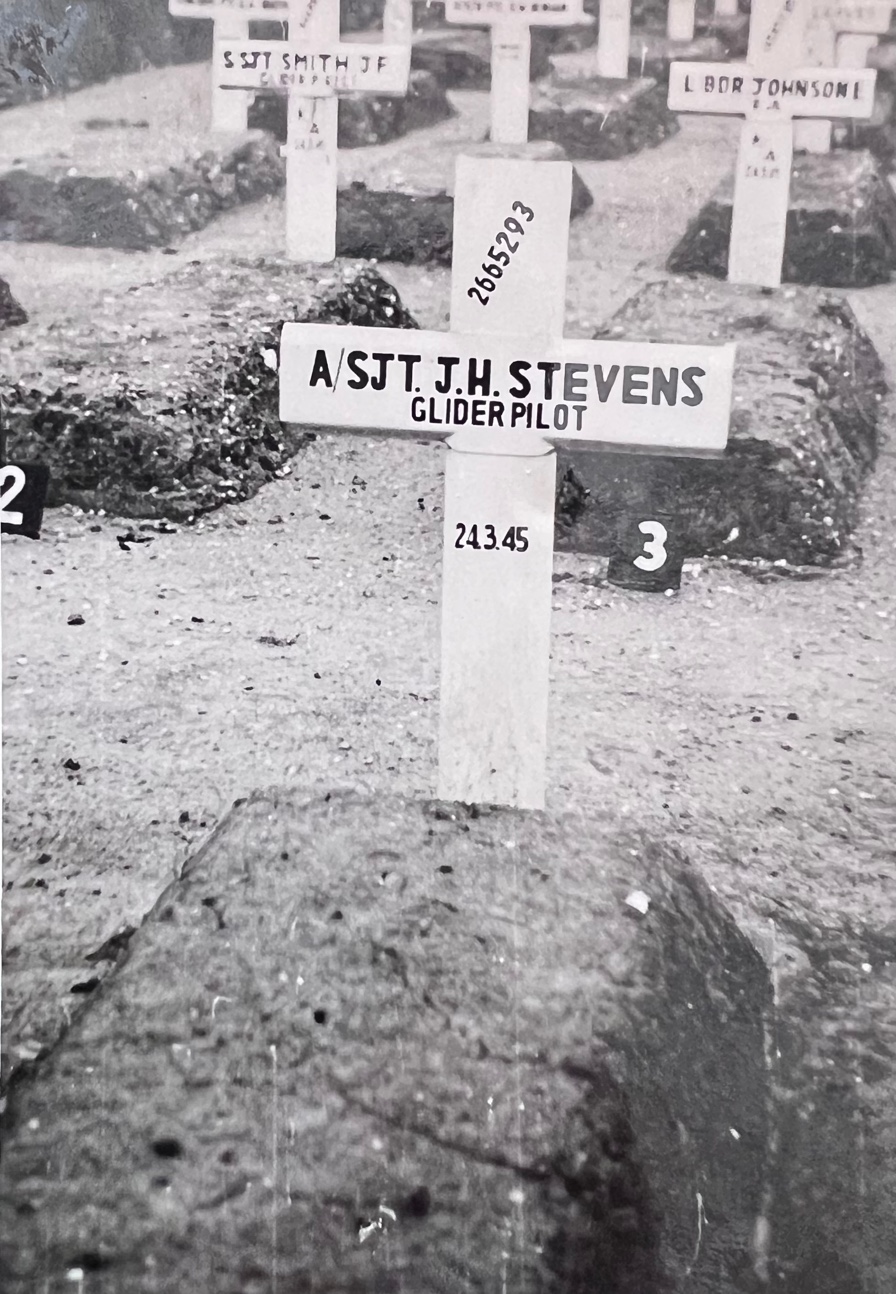
The cross reads:
2665293 / A/SJT J.H. STEVENS / GLIDER PILOT / 24.3.45
Neighbouring graves: S.SJT Smith J.F. (Glider Pilot) and L Bdr Johnson I. (R.A.).
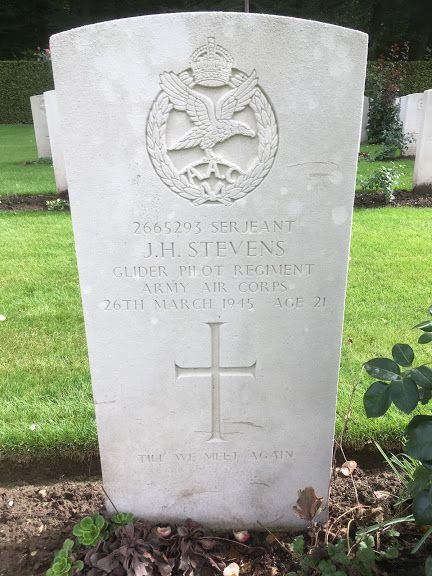
The post-war CWGC consolidation programme moved him to Reichswald Forest War Cemetery, Germany. His mother was notified in December 1946. When the permanent headstone was being prepared in 1950, she chose the inscription:
“Till We Meet Again”
He lies at Plot 38, Row F, Grave 3.
The Human Cost
F Squadron lost 44 men in the operation — killed, wounded, or missing. Of 60 gliders that took off from Gosfield, many were destroyed by anti-aircraft fire or crashed on landing in poor visibility. The pilots who survived the landing then fought as infantry, holding their positions against enemy armour and counter-attacks for three days before crossing back over the Rhine.
John Stevens did not survive the landing.
Sources: National Archives WO 171/5129 — No. 1 Wing GPR War Diary, F Squadron entries March 1945; Pegasus Archive VARSITY Roll of GPR Casualties; War Office Form E.2 burial notification (family custody); battlefield cross photograph (family custody).