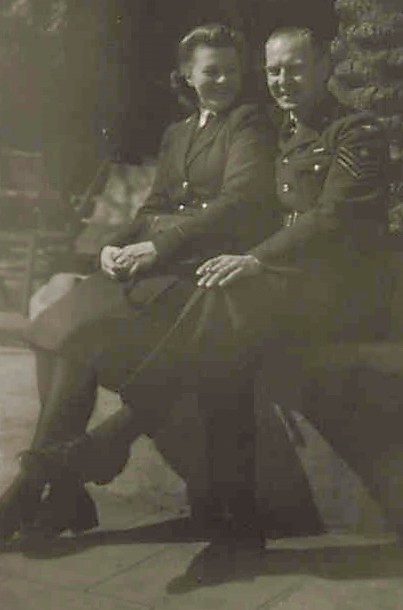
By the time Walter arrived at No. 2 RAF General Hospital in October 1943, he had been writing for two years.
Two volumes of diary. Iraq, Libya, Tunisia, Sicily, Italy. Fourteen months at RAF Habbaniya with its fortnightly dances and organised cricket. A 500lb bomb in Tripoli that threw him across a room. A live minefield near Sfax reversed to safety. The ruins at Sabratha. A glimpse of Churchill and Eden on a roadside near Carthage. Mount Etna from 5,000 feet. Shrapnel in a Catania park — half an hour behind a tree, fragments in the trunk above his head. He recorded all of it in the same matter-of-fact tone he used for cricket scores.
He had not yet met Margaret.
Algiers
The hospital sat on a hill above Maison Carrée, east of Algiers. There was a view of the sea. Volume III of the diary opens with a currency note inside the cover — N.A.F., 200 to the pound, Bank of Algiers — and then settles quickly into the familiar rhythm: the lab at the end of a long corridor, cricket, football, dances.
Walter had a gift for settling in. Every posting in the diaries follows the same arc: arrival, orientation, the gradual construction of a life within whatever space the war had assigned him. Algiers was no different.
He had been there a few weeks when, one Sunday afternoon in early October, he came back from football and walked past a sister’s office window.
She was sitting at her desk, writing.
The question
He went in. He was in football kit, his hair in disarray. He asked her to the Sergeants’ Mess dance.
She said yes.
Her name was Margaret Notley.
Walter recorded this in the diary with the same economy he brought to everything else — the fact of it, the football kit, the hair. What he does not record is what he was thinking when he stopped at that window. Two years of diaries and he did not write that down.
The dance at the Sergeants’ Mess was followed by an invitation to a Y.W.C.A. dance — cancelled, so they went to the pictures instead. A great liking formed, he wrote. The phrase, in context, is not understatement. It is the only register he had.
October to December
The sequence that follows in Volume III is the warmest passage in all three diaries.
October: the Sgts Mess dance. The Y.W.C.A. evening. A birthday party. Walter fell ill with infectious hepatitis and — characteristically — asked to be placed on her ward. He was out in nine days.
November: concerts, cinemas, the theatre. They went to the Teatro San Carlo on 1 January 1944 — he kept the ticket.
December: they were together constantly. Picnics. Dances. Everywhere, as he put it, together.
Christmas Day: he spent it on her ward. Two shows. Finished at 11.30pm, exhausted. A cup of tea with Margaret.
Boxing Day: he slept three hours, then dinner and a dance. With Margaret all the time.
That night he wrote his final diary entry.
What she was doing when he walked past
Walter’s account ends with I was more than fond of her. Margaret left no equivalent. But the autograph book, the qualifications, the photographs from Ward B.I. — taken together, they suggest something about the woman sitting at that desk in October 1943.
She had been nursing for eight years. She had held two qualifications, taken in an unusual order, which suggests someone who thought carefully about what kind of nurse she wanted to be. She had left London for Hythe during Dunkirk, served at Halton and Cosford, and made her way to North Africa. The people who had worked alongside her had written poems about her. They called her Peggie, they noted her Irish smile and her soft voice, and they had given her a send-off in rhyming verse at every posting.
She was sitting at her desk, writing. She was thirty years old. She had been working her way toward this posting, as he had been working his way toward it — across two years and three thousand miles of war — without either of them knowing it.
He stopped at the window.
She said yes.
The last line
I was more than fond of her.
The page after is blank. He never wrote again.
Three volumes, two years, over a thousand paragraphs — and then silence. Not the silence of someone who stopped caring about recording things. The silence of someone who had found what he was looking for and no longer needed to look.