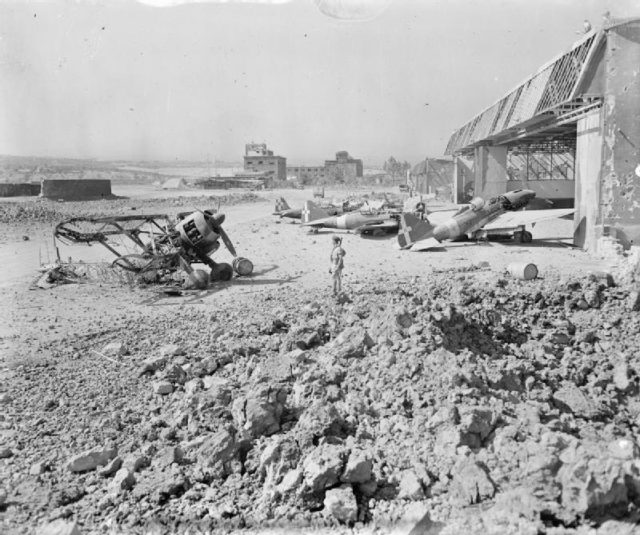
Catania airfield, Sicily — wrecked Italian fighters outside bomb-shattered hangars shortly after the RAF occupied the airfield. Walter’s unit moved into Catania in September 1943. © IWM (CNA 1352)
On 31 July 1943 Walter boarded a DC3 at Castel Benito and flew north. The aircraft stopped at Malta — at Luga, where the runways were still pocked from the siege — and then continued to Sicily. He landed at Cassibile, five miles from Syracuse, in an almond grove. The invasion had begun three weeks earlier. The fighting had moved north. Walter’s unit set up in the grove and waited.
Sicily was different from everything before it. The desert had been vast and empty and monochrome; Sicily was dense and green and complicated. The towns were intact. The roads were lined with trees. There were cinemas.
“So you could choose what shows you wanted to see & if you usually managed to get in.” Volume II — on the cinemas at Catania. A sentence that speaks volumes about what came before.
Catania
On 11 August Walter drove to Catania to collect equipment. On the road in, he passed a bridge the men called the Hedley Verity bridge. Verity was one of England’s finest cricketers — a slow left-arm bowler from Yorkshire — fatally wounded leading his company across it in July. Walter, who had organised cricket clubs across two countries, noted the bridge by name. He did not elaborate. He did not need to.
Verity died in a prisoner of war camp on 31 July 1943 — the same day Walter flew into Sicily. He was thirty-eight. Walter’s mention of the bridge is brief and deliberate; the weight sits just beneath the surface of the prose.
By September 25 M.R.S. had moved into Catania. The unit occupied the Commercial Institute, converted into a hospital. G/Cpt. O’Malley inspected Walter’s laboratory and was sufficiently impressed to begin pursuing a promotion to third stripe on his behalf.
Etna and the park
In October there was a weekend at a convalescent home on the slopes of Mount Etna, five thousand feet up — cool air, a proper building, a view over the island and the sea. The contrast with the desert was almost disorienting.
Back in Catania, returning through a park one evening, shrapnel began falling around them. Walter pressed himself against a tree and stayed there for half an hour while fragments struck the trunk above his head. Then it stopped. They walked on.
He wrote it the same way he wrote about the cricket.
Volume II diary scan (PDF) Full transcription (PDF) Narrative version (PDF)