Walter Kenneth Stevens left England in August 1941. He was in his early twenties, a trained laboratory technician, and he had no particular idea how long he would be gone.
The journey was not a short one. Troop ships in 1941 did not sail the Mediterranean — the sea was contested, and largely closed to Allied convoys. Instead Walter went south through the Atlantic, around the Cape of Good Hope, and up through the Indian Ocean to the Persian Gulf. It took weeks. His convoy was escorted for part of the journey by HMS Repulse, a Royal Navy battlecruiser.

The ship. Walter’s ship was the Orontes, a two-funnelled Orient Line liner he boarded in Glasgow on 28 August 1941 and left at Bombay on 22 October. She was the commodore’s ship of the convoy, known in the Admiralty’s records as WS 11, which was escorted by HMS Repulse. Its published sailing record matches Walter’s diary: Freetown, Cape Town on 30 September, and a second section picked up off Durban. Eighty-five years on, her voyage can still be traced in outside records. The Royal Museums Greenwich holds the Orient Line’s voyage reports and log extracts for the Orontes, 1941–47, and we hope to see what they say about this crossing. After the war she returned to the Australia run and was scrapped in Spain in 1962 (SS Orontes on Wikipedia).
“My first impression of Algiers was rather a thrilling one, because I saw it all lit up at night & this was the first time I had seen lights in a harbour since being in Cape Town.” Volume III — Walter on arriving in Algiers, remembering Cape Town
His first foreign harbour was Cape Town — and Cape Town at night was a revelation. After the blackout of wartime Britain, the sight of a lit harbour was something he had almost forgotten was possible.
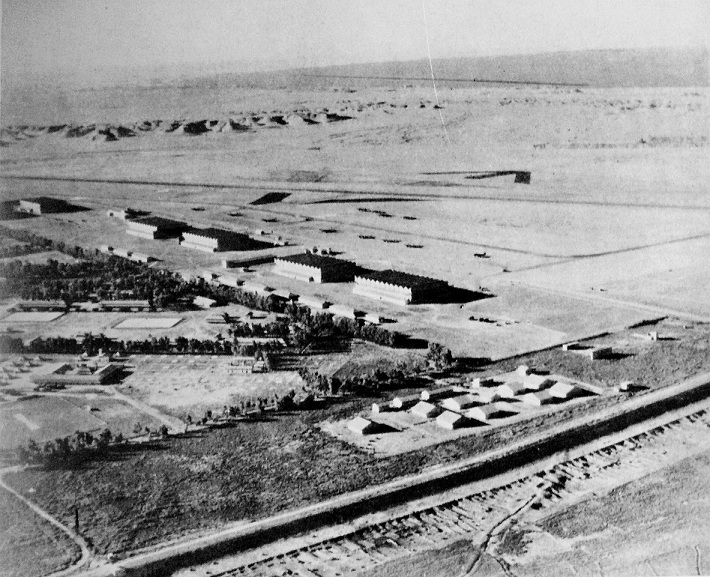
RAF Habbaniya, c.1941. The base Walter arrived at in late 1941 — the Euphrates in the middle distance, desert beyond the wire. Source: Wikimedia Commons / British military.
He settled into Habbaniya quickly. He found his laboratory — smaller than hoped, but clean and well equipped. He got his place in the football team. Within a month, his promotion to Sergeant had come through. The work was constant: malaria blood slides, bacterial cultures, samples from men whose bodies were fighting the desert as much as any enemy.
He was, by his own account, very happy in his job. That was all he worried about.
Among the items Walter kept from this period are a typed poem about Habbaniya, circulated among the station’s airmen, and his laboratory study notes in S.O. Book 137. The poem’s refrain says everything about the gap between appearance and experience: to passers by it looked like a fairyland, to us inside three bloody years.
Volume I diary scan (PDF) Full transcription (PDF) Narrative version (PDF)