The book begins with an ownership inscription. Inside the front cover, in her own hand: her name, her address, the date. It is the most straightforward thing she wrote in it — after that, the pages belong to other people.
Autograph books were a common wartime keepsake. You passed them around. People wrote poems, jokes, quotations, sketches. Some wrote carefully, in their best hand. Some dashed off a line and signed it. A few wrote something that suggested they had been thinking about what to say for a while.
Margaret’s book runs from 1940 to somewhere into the war years. Thirty-four pages. The handwriting changes — different inks, different hands, different moods. It crosses postings: Hythe in Kent, RAF Halton, RAF Cosford, and later, the Canadians who suggest a posting further afield. It is a record of a career in motion and of people who did not want to let go without leaving a mark.
What she wrote herself
Page 7 is hers. A short verse, signed with her name and the location: ‘Taint, Hythe, 1940. It is the only page where she speaks directly. Everything else in the book is addressed to her or written about her.
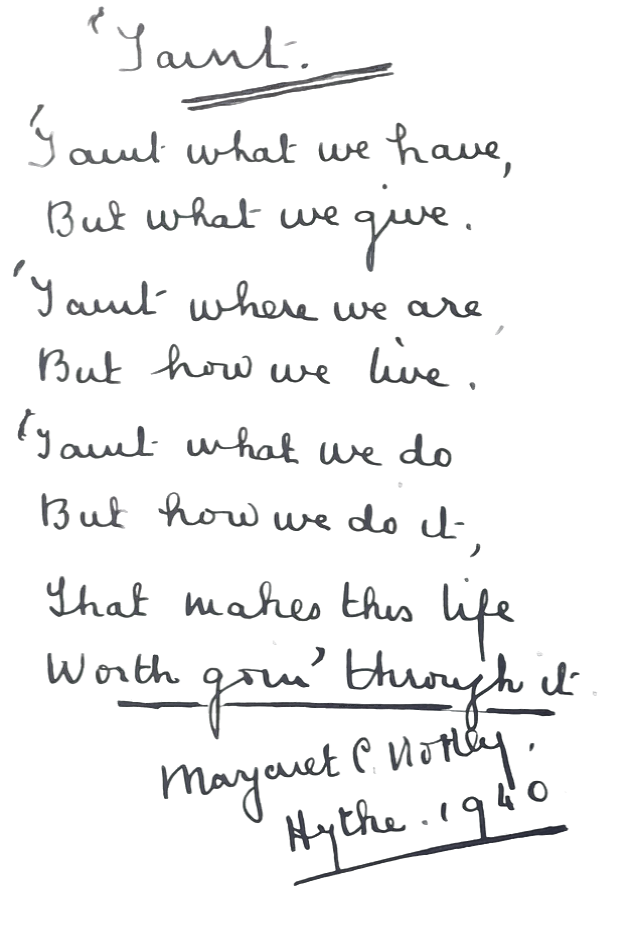
She chose something light — a little self-deprecating, the kind of thing you write when you do not want to seem as though you take yourself seriously. The handwriting is neat and practised. A nurse’s hand.
What they wrote about her
The Hythe entries cluster around a departure date: 20 June 1940. Dunkirk had ended three weeks earlier. The entries from that period have a particular tone — people writing quickly, people about to move, people who did not know when or whether they would see each other again.
Several entries from this group describe her in the same terms: reliable, warm, funny. One uses the phrase Irish smile — she was not Irish, but something about her manner apparently suggested it. Another notes the turned-up nose. A third calls her voice soft and gentle.
They called her Peggie.
OUR NOTLEY
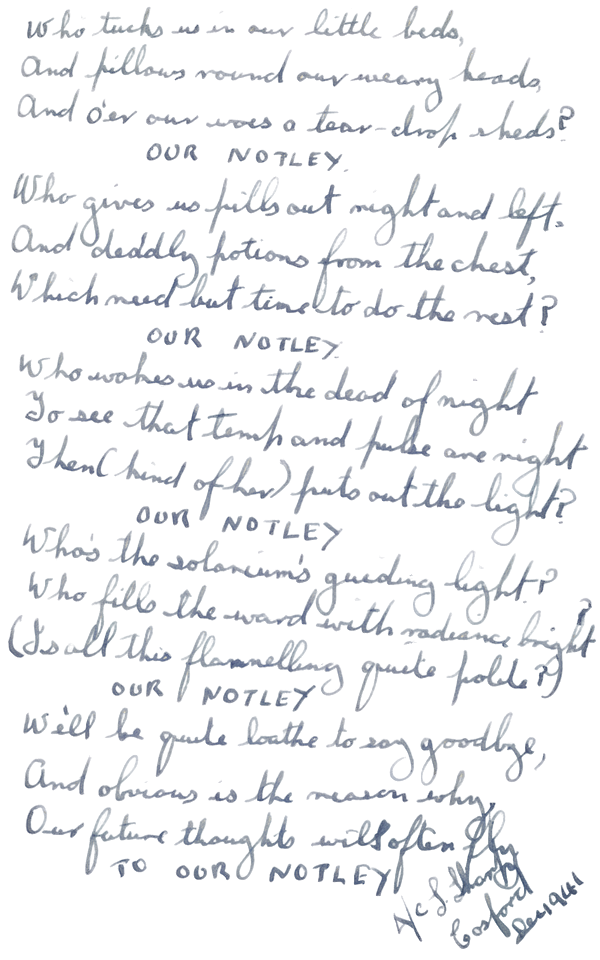
Page 32 is the centrepiece of the book. A colleague at RAF Cosford — A.C.J. Stanley — wrote a poem in December 1941 and gave it a title in capital letters: OUR NOTLEY. It runs to several stanzas. The refrain:
Our Notley, aye our Notley, We’re all so fond of you.
It is affectionate and entirely sincere. Stanley describes her on night duty, her patience with difficult patients, her manner with the ward. One line notes an accent vile, a heart of gold — the same affectionate tone as the Irish smile entry, the kind of teasing that only works between people who are genuinely fond of one another.
At Cosford she was known to patients as Red — possibly a reference to a reddish tint in what other entries describe as blonde hair with a golden sheen.
The Canadians
Several entries come from Canadian servicemen, which places Margaret at a posting where Allied personnel mixed. One calls her Lady of the Snow Country — a Canadian writing to a woman born in British Columbia, though she had left as a child and had no memory of it. Another is signed Asserstine; another Slim. They write with the directness that characterises the Canadian entries throughout the book: less formal than the British ones, warmer in a different register.
The crashed pilot
Page 17 is landscape — it has been rotated in the original, written sideways across the page, which suggests it was added informally, perhaps handed back quickly. It is signed Johnny, dated 9/4/42, and the inscription reads: Per ardua ad plasta — a play on the RAF motto Per ardua ad astra, substituting plasta (plaster, as in bandage). Johnny had been a patient.
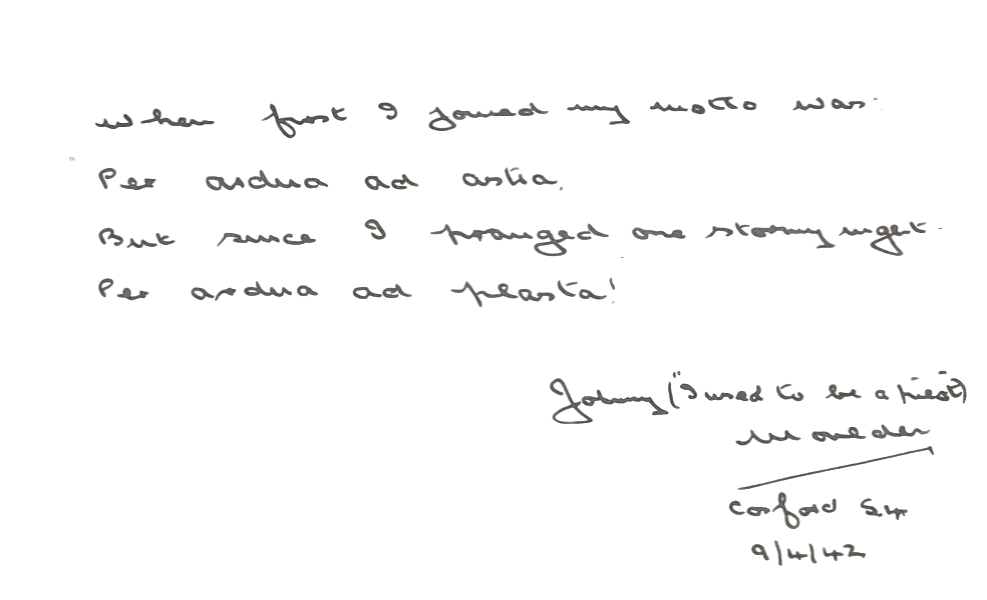
The joke requires knowing that she was a nurse and he had needed one. It is the kind of thing you write when you are well enough to be funny about it.
Charing Cross Hospital
One typed entry — unusual among the handwritten pages — is a farewell from Charing Cross Hospital in London, where Margaret had worked before the war. It is signed by a group. LS-02 in the archive catalogue. It marks a transition: from civilian nursing into the military postings that would follow.
What the book tells us
The autograph book does not tell us much about Margaret’s inner life. That was not what autograph books were for. What it tells us is how she appeared to the people around her — across five years, across multiple postings, across nationalities and ranks and circumstances.
She appears consistently: calm, capable, warm, with a quality that made people want to mark the moment of leaving. Twenty entries, perhaps more. Not one of them is perfunctory.
Walter walked past her office window in October 1943 and saw her writing at her desk. He had seen her before — at a distance, at dances — but this was the moment he stopped. By December they were spending every day together. On Boxing Day he wrote his final diary entry.
He already knew what the autograph book had been saying for three years.
Download: Autograph book scan — original, 34 pages
Download: Loose sheets — original scans, 10 pages
Download: Autograph book and loose sheets — transcription
← Back to Margaret Notley Stevens Forward to Nursing Sister →